Investigating the Impermeability of Various Products and Protocols of Crystalline Waterproofing Technology
by Radi Al-Rashed and Maher Al-Jabari
Conference Paper
Proceedings of the 17th International Conference on Durability of Building Materials and Components (DBMC 2026)
Montreal, Canada – July 20 – 24, 2026
Abstract
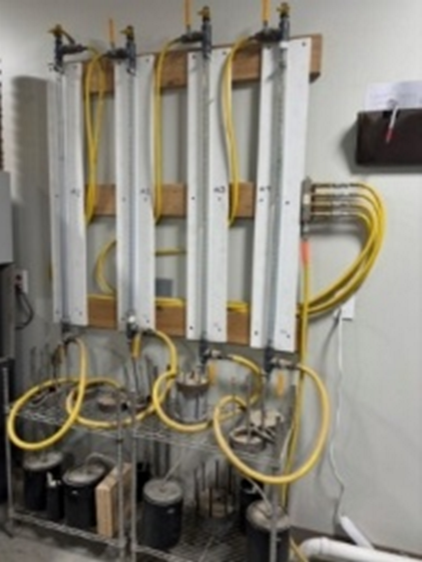
Concrete buildings and infrastructures encounter several durability issues that are caused or associated with water penetration. Hence, the durability of concrete is correlated to its hydraulic impermeability. In this paper, the waterproofing performance of four types of crystalline waterproofing materials are investigated, the materials being in solution and powder forms. They all involve pore blocking functionality, while some of them involve additional pore lining properties. These included MCE as an admixture, PaviX and SofiX, as crystalline penetrating concrete sealers and ChemCreteX as a cementitious powder slurry coating. The application protocols investigated included two dosages of 1% and 2% of MCE admixtures with or without an additional topical Pavix treatment. The standard permeability testing method was used (U.S. Corp. of Engineering CRD-C48-92) to measure the permeability coefficient of control and crystalline waterproofed concrete samples. The results cover various mix designs utilizing two types of cements (Portland cement and 1L limestone cement) and with various water to cementitious materials (w/cm) ratios. The findings show the efficacy of each of the investigated crystalline technology, in liquid and powder form, for surface treatment (sealer or cementitious coating) as a pore blocking material and for MCE as a Permeability Reducing Admixture at Hydrostatic pressure (PRAH).
Keywords: Concrete, Moisture, Permeability, Waterproofing, Crystallization, Durability, CRD-C48-92, PRAH.