
Porosity, Water Absorption and Abrasion Resistance of Concrete Dosed with Multi-Crystalline (MCE) Waterproofing Admixture: Comparing Two MCE dosages with Control Concrete
by Radi Al-Rashed and Maher Al-Jabari
International Journal of Civil Infrastructure (IJCI)
Volume 9, Year 2025
ISSN: 2563-8084
DOI: 10.11159/ijci.2026.005
Abstract
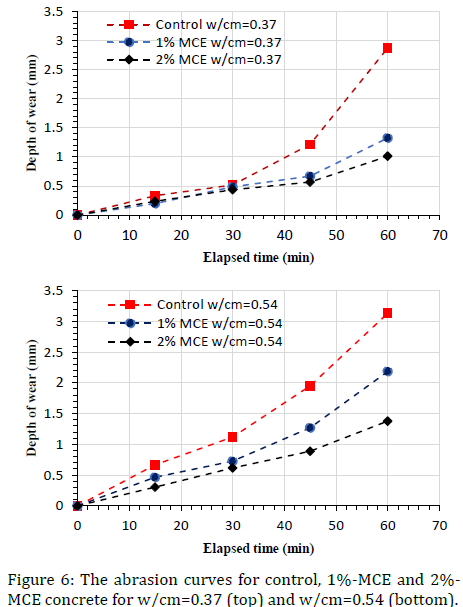
Concrete durability issues are associated with water penetration and concrete porosity in addition to its strength. This paper investigates the performance of liquid multi crystalline waterproofing admixture (MCE) manufactured by International Chem-Crete Corporation (Dallas, TX, USA). The investigation included the two dosages of 1% and 2% MCE by the weight of cementitious materials compared to control concrete. The standard testing methods described in ASTM C642 was used to measure density, water absorption and volume fraction of permeable pores for reference and MCE-dosed concrete specimens. Furthermore, the standard testing method described in ASTM C779 was used to measure abrasion resistance for reference and MCE-dosed concrete specimens. These experiments were performed using the mix design of Iowa Department of Transportation (Iowa DOT) with various ratios of water to cementitious materials (w/cm) ranging from 0.37 to 0.54. The results are presented as curves of water absorption, fraction of permeable pores, density and abrasion resistance for reference and 1% and 2% dosed concrete as functions of w/cm ratio. The findings demonstrate the efficiency of each of the investigated dosages of MCE in pore blocking waterproofing. MCE reduces the fraction of permeable pores and water absorption at the two dosages, with a slight densifying effect at 2% MCE and a significant increase in the abrasion resistance. MCE functions very well with 1% dosage, however, additional performance is obtained with 2% dosage. At high w/cm ratio, 2% MCE is recommended
Keywords: Concrete, moisture, pores, absorption, waterproofing, crystallization, durability, ASTM C642.